In Thailand, researchers wanted to observe two species of otters: the smooth-coated otter and the Asian small-clawed otter. Researchers wanted to see how they interacted with each other, with humans, and how they were affected by human-dominated land areas, which include agriculture, cities, and aquaculture. This research is important for the conservation of these species. The researchers wanted to understand how environmental factors and human interactions influence the otters’ daily activity patterns.
The east and west coasts of southern Thailand are areas where otters have a natural habitat, but these areas are also being changed by human populations. The Andaman Coast, or the west coast, is more of a natural habitat while the Thai Gulf Coast, or the east coast, is more urbanized. Researchers wanted to use these areas to conduct their study, so they placed 1,137 cameras at random in certain gridded areas in mangroves and peat swamps where otter populations are high. These cameras took pictures continually for 25 days at a time for several years. In front of the cameras were socks soaked in fish oil, which drew the otters to the camera without baiting any other animal. Using a newer, two-occupancy model that incorporated both spatial and temporal patterns, they were able to analyze different types of land that was used, available prey, and human presence/interactions. This model allowed them to evaluate the change in activity in response to other otters as well as humans.

The study showed that otters prefer their natural habitat, areas like mangroves, marsh swamps, and places with aquaculture. More specifically, on the Andaman coast, smooth-coated otters avoided areas with high foot traffic. On the same coast, small clawed otters were actually more detectable where there were more humans, but this is likely due to the lack of smooth-coated otter populations. On the Thai Gulf coast, otters were more likely to abide in areas that overlap with urban patches. They found that on the Thai Gulf, the small-clawed otters shifted to a more nocturnal pattern, while smooth-coated otters remained the same, mostly diurnal. The smooth-coated otters seemed more adaptable in the presence people, while the small-clawed otters were not as adaptable. Overall, human presence did not effect occupancy as much as it did detection.
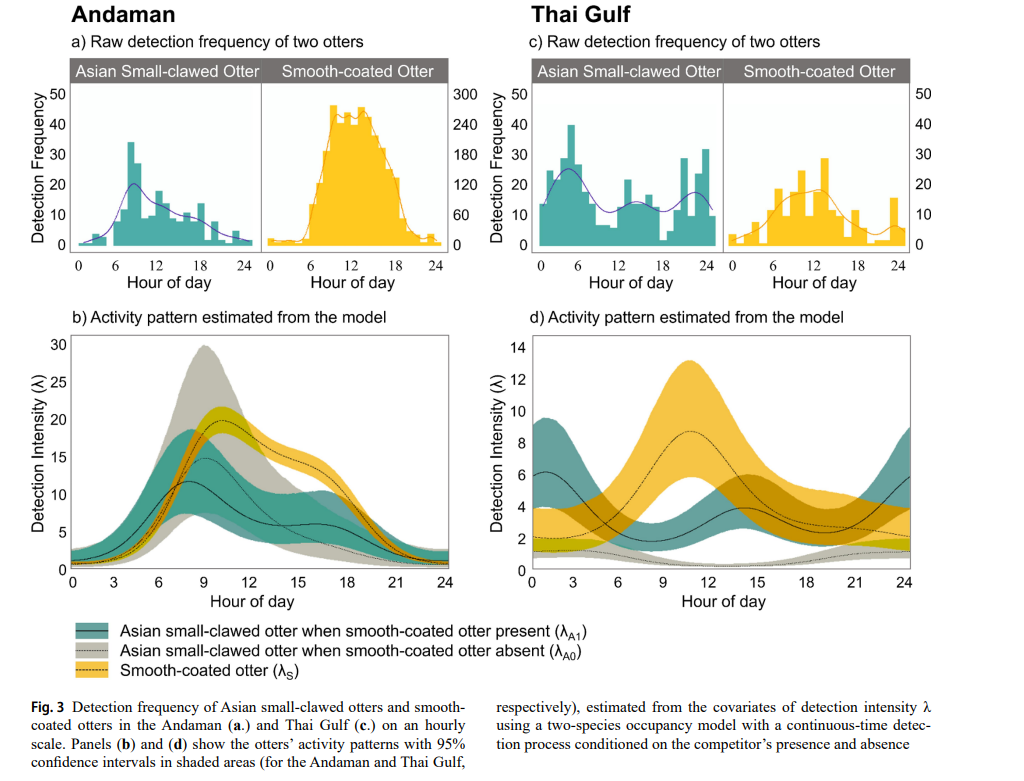
This study shows that both species of otter are adaptable to human interactions in urban-sprawling areas, but it also shows that their coexistence is dependent on habitat structures and frequency of human interactions. I found it interesting that human presence did not necessarily drive away most otters, but instead, it affected where they were most active. I would love to see future studies that look at this, but in a different way. I think that GPS systems could be used to allow the tracking of otters and how they move over a longer period of time. This would also reduce the need for baiting the cameras, which would reduce bias in the study. Overall, the research provides valuable insights into how species with overlapping niches can adjust their behavior to coexist, while also reminding us of the importance of preserving natural habitat corridors in mixed-use landscapes.
Reference
Tananantayot, J., Tantipisanuh, N., Kamjing, A., Dachyosdee, U., & Ngoprasert, D. (2024). Understanding the co-occurrence of asian small-clawed otter and smooth-coated otter in a human-dominated landscape. Behavioral Ecology and Sociobiology, 78(11), 112. doi:https://doi.org/10.1007/s00265-024-03532-w