Understanding the co-occurrence of Asian small-clawed otter and smooth-coated otter in a human-dominated landscape

Posted on

In Thailand, researchers wanted to observe two species of otters: the smooth-coated otter and the Asian small-clawed otter. Researchers wanted to see how they interacted with each other, with humans, and how they were affected by human-dominated land areas, which include agriculture, cities, and aquaculture. This research is important for the conservation of these species. The researchers wanted to understand how environmental factors and human interactions influence the otters’ daily activity patterns.

The east and west coasts of southern Thailand are areas where otters have a natural habitat, but these areas are also being changed by human populations. The Andaman Coast, or the west coast, is more of a natural habitat while the Thai Gulf Coast, or the east coast, is more urbanized. Researchers wanted to use these areas to conduct their study, so they placed 1,137 cameras at random in certain gridded areas in mangroves and peat swamps where otter populations are high. These cameras took pictures continually for 25 days at a time for several years. In front of the cameras were socks soaked in fish oil, which drew the otters to the camera without baiting any other animal. Using a newer, two-occupancy model that incorporated both spatial and temporal patterns, they were able to analyze different types of land that was used, available prey, and human presence/interactions. This model allowed them to evaluate the change in activity in response to other otters as well as humans.

The study showed that otters prefer their natural habitat, areas like mangroves, marsh swamps, and places with aquaculture. More specifically, on the Andaman coast, smooth-coated otters avoided areas with high foot traffic. On the same coast, small clawed otters were actually more detectable where there were more humans, but this is likely due to the lack of smooth-coated otter populations. On the Thai Gulf coast, otters were more likely to abide in areas that overlap with urban patches. They found that on the Thai Gulf, the small-clawed otters shifted to a more nocturnal pattern, while smooth-coated otters remained the same, mostly diurnal. The smooth-coated otters seemed more adaptable in the presence people, while the small-clawed otters were not as adaptable. Overall, human presence did not effect occupancy as much as it did detection.
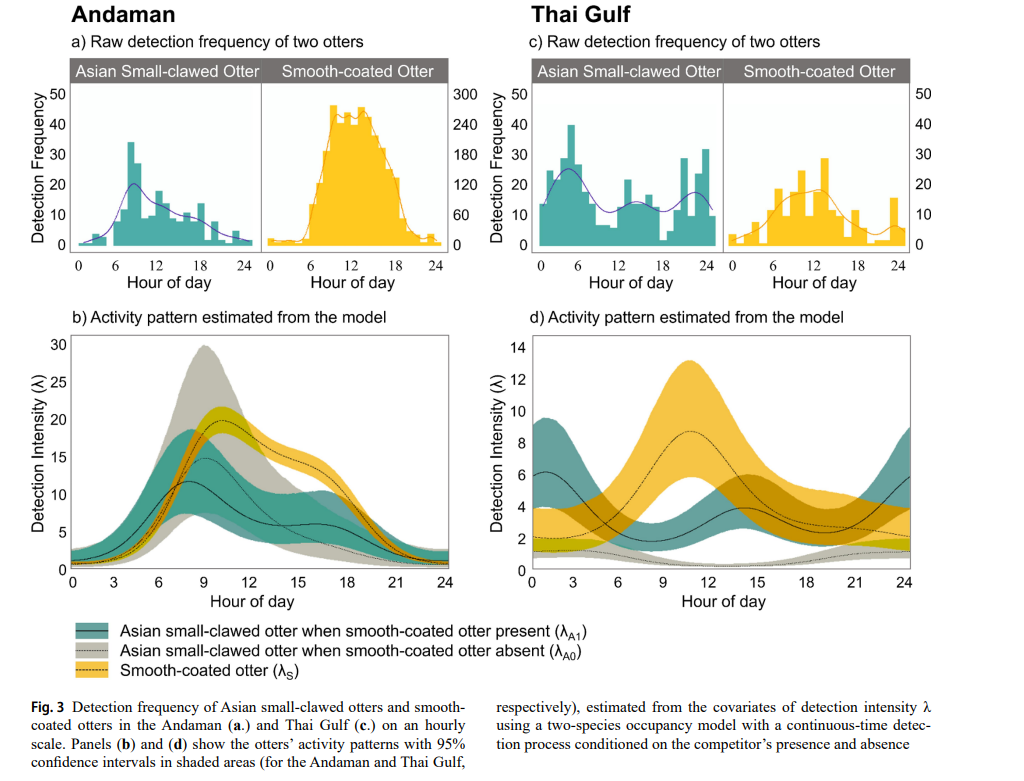
This study shows that both species of otter are adaptable to human interactions in urban-sprawling areas, but it also shows that their coexistence is dependent on habitat structures and frequency of human interactions. I found it interesting that human presence did not necessarily drive away most otters, but instead, it affected where they were most active. I would love to see future studies that look at this, but in a different way. I think that GPS systems could be used to allow the tracking of otters and how they move over a longer period of time. This would also reduce the need for baiting the cameras, which would reduce bias in the study. Overall, the research provides valuable insights into how species with overlapping niches can adjust their behavior to coexist, while also reminding us of the importance of preserving natural habitat corridors in mixed-use landscapes.

Reference

Tananantayot, J., Tantipisanuh, N., Kamjing, A., Dachyosdee, U., & Ngoprasert, D. (2024). Understanding the co-occurrence of asian small-clawed otter and smooth-coated otter in a human-dominated landscape. Behavioral Ecology and Sociobiology, 78(11), 112. doi:https://doi.org/10.1007/s00265-024-03532-w

Critical Review: “Returning neighbors: eastern wild turkey (Meleagris gallopavo silvestris) occupancy in an urban landscape”

Posted on

Abstract: Due to hunting and habitat loss, wild turkeys in early America reached very low population sizes. In the last 50 years, America as a country has implemented different laws and regulations to attempt to increase the number of turkeys in the wild, which is working! With this exciting news, human interactions with turkeys in highly populated areas are a rising issue. Wild turkeys seem to be recolonizing in urban areas, specifically Washington, D.C.. Researchers aimed to determine which urban areas are most affected by wild turkey populations and how those wild turkeys are using the urbanized land.

Methods: 75 studies across Washington, D.C. were conducted. These studies were conducted in random green spaces, consisting mostly of parks and occasionally, a cemetery or golf course. Each of these points was 2 km apart, to ensure coverage. Multiple brands of trail cameras were deployed from July 2020 to November 2023 and were active 28.7 days per sampling. With 4 different sampling trials lasting 30-45 days each, these cameras observed assorted landscape features as well as turkey sightings. These landscape features include human population density, vegetation coverage, impervious coverage, and distance to roads or water. The final number of turkeys observed by the trail cameras was 2,656, showing up at 32 different sites.

Figure 1: “Location of the 75 sampling sites used to estimate wild turkey (Meleagris gallopavo silvestris) occupancy across the Washington, D.C. metropolitan region, USA (38.9072° N, 77.0369° W). The size of the circles represents the total number of wild turkey detections at each site from July 2020 to November 2023.”

Results: The result of this study was the sighting of 2,656 wild turkeys at 32 of 75 different sites. Of the sites, 29 were public parks, 2 were cemeteries, and 1 was a golf course. Wild turkeys were on average detected 22.9 days per season, being more detected in the spring. The results showed that the average wild turkey occupancy was 7% (95% CI = 0.04–0.10) across the region. Increased distance from roads and increased vegetation increased the probability of turkey presence, or positive correlations. Increased distance from water and decreased canopy height/vegetation coverage both reduced the number of turkeys present, or negative correlations. Overall, the data shows that turkeys favored areas close to water with moderate canopy coverage that is also away from roads/traffic.

Conclusions: Research shows that wild turkeys can survive successfully in urban green spaces, specifically ones that mimic the natural habitat of a wild turkey. These areas are near open water, are away from traffic, and have moderate canopy coverage from foliage. This leads to a possible management effort that involves reducing roads being paved in larger urban green spaces, focusing on keeping populations away from roadways, and creating patches of canopy coverage on smaller scales.

Critical Analysis: I think that this is a very well executed research article, and it is one of the first of its kind. The research shows a valuable insight on how wildlife adapts to urbanization, despite population increases. The method of collecting data was ingenuitive, ensuring minimal errors. Some limitations of this research is the area limit. Only conducting research in Washington, D.C., limiting applications to other areas. The occupancy rate being low (7%) also limits the use of the data in other areas.

Reference: Collins, M. K., Edwards, K. E., Bates, S., & Gallo, T. (2025). Returning neighbors: eastern wild turkey (Meleagris gallopavo silvestris) occupancy in an urban landscape. Journal of Wildlife Management. https://doi.org/10.1002/jwmg.70129

Urbanization and the Ecology of Wildlife Disease: Summary and Analysis by Sophia Skinner

Posted on

This study focuses on the impact that urbanization and human interactions have on the gut microbiome of wildlife. These animals that come into contact with humans have shown that they have differences in their microbiome, rather than other animals of the same species that are deep in the woods with no human contact. The process of animal microbiomes becoming more like people’s is called “humanization” of their microbiome. This is a very important factor when studying human-animal interactions in urban areas, because these distinct changes are indicators of urbanization.

The research performed in this study was done on 3 different animals: anoles, coyotes, and sparrows. These animals were tested in both urban and rural areas around the world. Some samples were taken from Puerto Rico, some were from California, and others, like Venezuela or Cameroon. The diversity of the animals and places reduced the amount of bias and error that the results would show. The more diverse the location and the species of animal, the more reliable the data. To compare the animal microbiota findings, the researchers compared these microbes to humans. The more similar they were to humans, the more humanization that occurred in the animal’s microbiome.

The results of the research showed that the closer an animal lives to an urban area, the more their microbiome reflects humans. The closer animals were to humans, the more human-associated bacteria there were in their gut. This clear shift in microbiome contents between wildlife coming into contact with urban areas/cities versus wildlife that lives in the wild indicates a clear humanization of microbiomes in animals.

Some changes or improvements that I would make for next time would be to look into more of the causes of why humanization occurs, rather than focus on whether or not it occurs. With this research, we know that it does happen, but I think it would be of better use to know where it stems from. For example, do animals that eat human trash have an increased number of human-associated microbes? Is that the number one cause of humanization of animal microbiomes? If not, then what is? Though it is important to know that humanization of microbes exists, I think the next area of research needs to focus on how animals are at an increased risk of exposure to human microbes, as well as how that impacts them.

Citation: Dillard, B. A., Chung, A. K., Gunderson, A. R., Campbell-Staton, S. C., & Moeller, A. H. (2022). Humanization of wildlife gut microbiota in urban environments. eLife11, e76381. https://doi.org/10.7554/eLife.76381